

It’s both exhilarating and sad to realize just how much has changed, and how much hasn’t since April 3, 1968, when a man who wasn’t wanted by those who he was trying to help stepped up to the pulpit of the Mason Temple (Church of God in Christ Headquarters) in Memphis, Tennessee.
The third chapter of Taylor Branch’s powerful trilogy on the Civil Rights movement, “At Canaan’s Edge,” captures the weariness felt by the Rev. Dr. Martin Luther King, Jr. when he stood that night. It also reminds us that this man who was so hated, so vilified, so ridiculed, who had been on the battlefield for a decade by the time the Voting Rights Act was signed, was still willing to put himself out there because people needed him.
In the last years of his life, Dr. King was being hit from all directions because he knew that battle was still ongoing:
The “liberal” north was angry with him because he had the audacity to say that cities like Boston that were just as racist as Birmingham, they just weren’t as open about it.
Younger Black people, the people who were benefitting the most from the efforts of King and the rest of the civil rights movement, were starting to turn on him, calling him “Tom” for his simple belief that reaching his “Beloved Community” was going to involve everyone, not just Black people, and that it couldn’t be accomplished with the blind anger that had Watts, Newark, Detroit and so many other cities burning;
The federal government, which had been the civil rights movements partner (and sometimes protector) had turned its back on him, because he was starting to talk openly about the waste of talent and treasure the war in Vietnam was, and that there was still a need to finish what had just started in this country less than a decade before.
And, of course, there were those pesky Saltine southerners, who even as they were busy changing their political affiliation from Democrat to Republican, still had time to curse King for altering their “way of life.”
But he went to Memphis because it was the right thing to do.
The trip to Memphis in support of striking garbage workers was one that his supporters didn’t want him to take. Some in Memphis’ Black community didn’t want him there because they felt his presence there would do more harm than good. The more “radical” factions of that same community didn’t want to him there because they felt he was “begging the white man for scraps.”
That didn’t stop him from doing what was right.
I wrote about how Dr. King’s 35 words from 1963 have become a sword and shield for far too many of my melanin lacking friends on both the right AND the left. We must admit that parts of his last public sermon have become similarly trapped in amber:
“I just want to do God’s will. And He’s allowed me to go up to the mountain. And I’ve looked over. And I’ve seen the Promised Land. I may not get there with you. But I want you to know tonight, that we, as a people, will get to the promised land!”
I’m guilty of that myself.
Why?
Because it voiced hope, and back then, just like now, hope is a precious commodity.
But you want to know something?
Dr. King’s last sermon was a sermon of condemnation, a sermon reminding everyone in the audience that night there was so much work that still needed to be done—from both sides.
It was in this sermon he mentioned that of all the periods of time he wanted to see it would have been a few more years of the second half of the 20th Century. Right after saying that he acknowledged:
“Now that’s a strange statement to make, because the world is all messed up. The nation is sick. Trouble is in the land; confusion all around.”
Sound familiar??
In 1968, he mentioned themes that reverberate 54 years later:
“The masses of people are rising up. And wherever they are assembled today, whether they are in Johannesburg, South Africa; Nairobi, Kenya; Accra, Ghana; New York City; Atlanta, Georgia; Jackson, Mississippi; or Memphis, Tennessee — the cry is always the same: ‘We want to be free.’”
Shortly after that, he gave a warning that resonates to this day—much to the chagrin of some people of a certain hue who wonder “haven’t we done enough for you colored folks?”
Back then and now, the answer is “no.”
“…if something isn’t done, and done in a hurry, to bring the colored peoples of the world out of their long years of poverty, their long years of hurt and neglect, the whole world is doomed.”
He reminded ALL SIDES the equation was simple—and the solution was just as simple:
“The issue is injustice. The issue is the refusal of Memphis to be fair and honest in its dealings with its public servants, who happen to be sanitation workers. Now, we’ve got to keep attention on that.”
And four decades before “24-hr news cycle” and talk show hosts who enjoy boosting their ratings and algorithms by focusing on the lowest common denominator, the most visceral reaction, he warned us what would happen:
“You know what happened the other day, and the press dealt only with the window-breaking. I read the articles. They very seldom got around to mentioning the fact that one thousand, three hundred sanitation workers are on strike, and that Memphis is not being fair to them, and that Mayor Loeb is in dire need of a doctor. They didn’t get around to that.”
1968, and Dr. King was describing to a T “divided/divisive” podcast hosts and AM/FM talk show hosts, who currently plague the airwaves and cyberspace.
(The really scary thing is he was describing a couple of the local pundits at least a decade before they were born.)
But in poking the eye of the White power structure, never forget that for Dr. King, non-violence was more than a catchphrase (like Make America Great Again). It was a sincere and sacred belief, and while he understood those who lashed out violently, he could not, would not, condone their actions. He reminded those who would call him “Tom” just how that played into the hands of the power structure they were trying to destroy:
“You know, whenever Pharaoh wanted to prolong the period of slavery in Egypt, he had a favorite, favorite formula for doing it. What was that? He kept the slaves fighting among themselves.”
But we should never forget that even with the condemnation, his final sermon was also an exhortation. It was a reminder that within the parable of the Good Samaritan there is a question that has been forgotten by too many:
“The question is not, “If I stop to help this man in need, what will happen to me?” The question is, “If I do not stop to help the sanitation workers, what will happen to them?” That’s the question.”
It would have been very easy for King to leave the battlefield; he had done more in 10 years than some people do in their lifetimes. But he lived his life with a simple belief.
“We must accept finite disappointment, but never lose infinite hope.”
So on the 54th Anniversary of when a coward took his life (a murder that 2-time Academy Award winner Walter Brennan celebrated with a dance), and with the continued effort to roll back the accomplishments that he gave his life for, take the time to read or listen to his “Mountain Top” sermon.
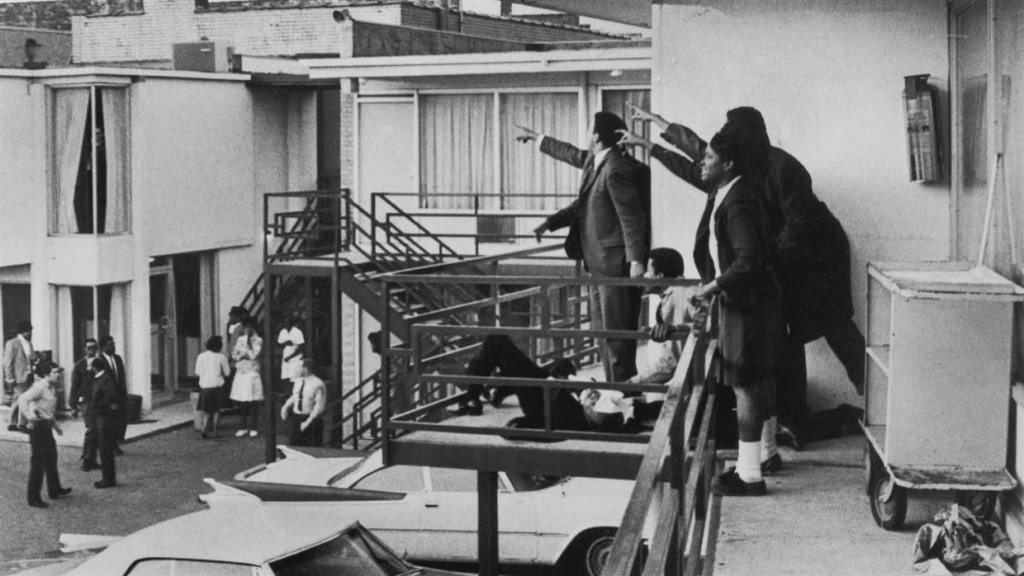
Learn a little more about a man who even when he had every right to be disappointed with humanity still believed there was a chance to do better, to reach that Beloved Community, and who understood that even though saw darkness knew that:
“When it is dark enough can you see the stars.”
Until Next Time…

