
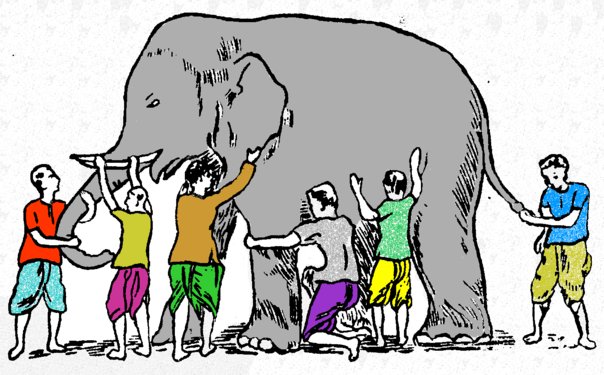
This summer—the last six months—have been a perfect example of the story of the blind men and the elephant—men without sight touching different parts of the massive creature and coming up with different conclusion of just what the animal was.
In 2020, every person has been touching the elephant and coming up with different conclusions on what is going on.
From the pandemic to the protests, on a national and local level, across all spectrums and all generations, much like the blind men, your perspective depends on where you’re touching the elephant.
You’re either “exercising your right to freedom,” or helping “perpetuate a virulent disease.”
You’re either supporting those who are “fighting back after 400 years of oppression” or speaking out for those brave men and women “who are protecting us from chaos in the streets.”
You’re either acknowledging there’s “a collective issue with the current structure of the criminal justice system that must be addressed,” or “we’re dismantling a perfectly good system because of a few bad apples.”
You see it in the memes and messages posted onto social media and in the stories disseminated in print and broadcast outlets.
This past week, Seattle has become a microcosm of the elephant story because of a series of events that lead to the retirement/resignation of the Chief of Police.
Those who are “touching” Carmen Best’s story from the perspective of “Seattle is dying,” are pointing out the chaos of a city and location—downtown—that they stopped coming into on a regular basis a decade ago.
There are older Black people—people who are the age of my oldest siblings (late 60’s—early 70’s) who are “touching” Best’s story from the perspective they grew up with, anger because after finally having “one of ours” work their way up the ladder and reach a position of authority, that person has been driven out. Worse yet, that person was driven out before they had a chance to “prove themselves,” akin to the “Last Hired, First Fired” scenario People of Color have had to endure forever.
On the flip side, younger Black people—those in their late teens to 20’s and 30’s—“touch” Best as “she may be Black, but she was in charge of a fundamentally flawed and/or racist organization whose focus has been on the perpetuation of the status quo.” So while concerned, there is not the visible anger that has been expressed by older Blacks such as the former King County Executive.
Seattle’s two most visible radio talk show hosts (AM and FM)—neither of whom live in Seattle, but make a lot a money bashing Seattle—“touch” Best as an opportunity to treat someone who at the beginning of the summer they said was letting chaos reign in the city as a conquering “hero,” a person who stood up to the “Marxists” running the Seattle City Council.
And then there’s everybody else, touching the Best “elephant” and still unsure of what the Hell is going on—which makes it par for the course for 2020.
“We” like our world to be (if you’ll excuse me for injecting color into this conversation) Black and White.
“Lock up all of the protestors/rioters” (White) vs. “Protests/Riots are the voice of the unheard” (Black).
“Blue Lives Matter” (White) vs. “ACAB” (Black).
“People should be just as angry about Cannon Hinnant as they are about George Floyd” (White) vs. “Both deaths were tragic, and those responsible should be prosecuted” (Black).
–By the way, the suspect in the death of Hinnant was quickly apprehended and is being held without bond—can we say the same for the suspects in the death of Mr. Floyd, or those responsible for the death of Breonna Taylor??
“Chief Best is a victim of an out of control City Council who enjoy making Seattle a Third-World country” (White) vs. “The actions of the SPD, directed by Chief Best, deserved to be examined to see if the systemic issues that are part of the current law enforcement model of the department that she was in charge of can be corrected or if the whole system needs to be dismantled and rebuilt” (Black).
The problem of Black and White (or White and Black) is that there is no room for discussion, for nuance.
Jim Hightower’s famous statement about there’s nothing in the middle of the road “But Yellow Stripes and Dead Armadillos,” is what America has become—two positions that can be called “Right” or “Wrong” “Black” or “White” “Liberal” or “Conservative” but no in-between.
Like the men with the elephant, what people “touch” has now become their position and nothing—NOTHING—will move them from that opinion/position. The unfortunate thing about this is that it means people are talking at each other instead of talking to each other. Where the conversations could develop a new color: gray.
Because there are times when there is a middle of the road, but only if people are willing to stop what they’re doing—see which sides message can be shouted the loudest—and LISTEN:
Folks responsible for property damage SHOULD face prosecution, but it should also not detract OR distract from the primary message that has put people into the streets since May 26.
Police serve a vital responsibility, but let’s be very clear, some cops—not all—but more than the “BLUE LIVES MATTER” crowd will ever admit, ARE BASTARDS (ACAB) and those bastards are taking the lives of Black and Brown (and on occasion White) people.
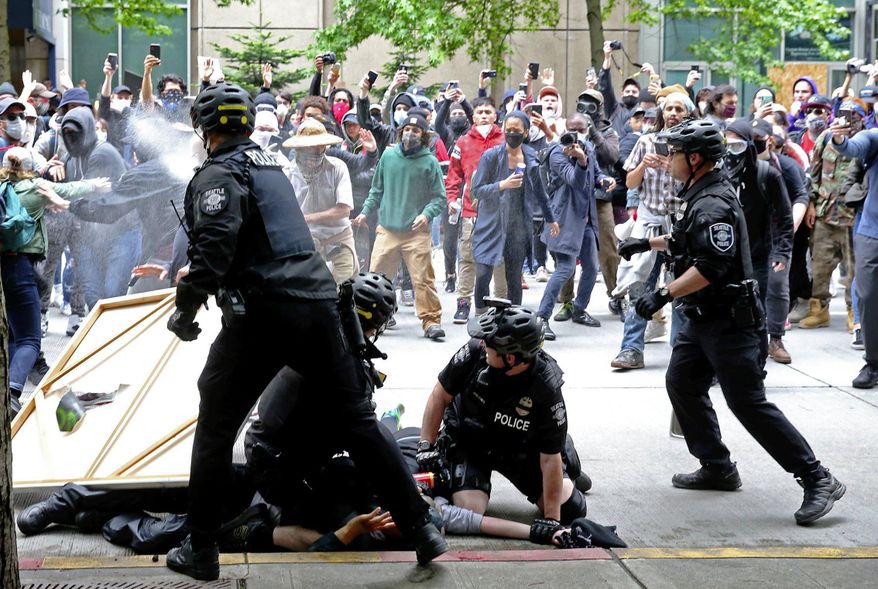
We need to be protected from those cops and start working on the system that allows them to act like bastards and get away with it. Acknowledging that it’s more than a “few bad apples” is the first real step toward building a new paradigm instead of patching up the old, failed system.
And most painfully, we need to acknowledge that while doing an incredible job during a difficult period in the city’s history, and that there are plenty of people whose fingerprints are on how she is leaving, as the Chief of the department, Carmen Best is responsible for the actions taken by the officers under her charge and the anger those actions have generated.
Is that fair? It’s as fair as the actions taken against the Police Chief who was in charge the last time Seattle was nationally recognized for being “out of control.” In the wake of the WTO riots, everyone started pointing fingers at the actions (or inactions depending on where you “touch the elephant”) of the SPD and started saying Chief Norm Stamper needed to take responsibility for what occurred.
Stamper’s way of “taking responsibility” was to resign/retire from the position.
You cannot (and I will not) deny or defend the ham-fisted way the City Council has proceeded this summer in a conversation that quite frankly we need to have, the rebuilding/restructuring of law enforcement in this city. It’s a conversation that MUST take place, and a conversation that sadly will now no longer have the voice of Chief Best as part of the mix.
The current model isn’t working, and we need to get under the hood and fix what has not been working as quickly as possible.
And that is only going to happen when people move, start touching other parts of the elephant and start discussing what they have touched going forward. It’s not going to be Black—and it’s not going to be White—but it may be something that will get us back to talking to each other.
There’s a good chance that in the end, neither side is going to be happy with the solutions that come from this, but as Henry Clay said: “A good compromise is when both parties are dissatisfied.”
We need to start working on compromise. Because we’re not all right, and we’re not all wrong.
We’re all just touching different parts of the elephant
Until Next Time.
 Thoughts From A Short Round Black Man
One thought on “Seattle and “Touching the Elephant””